
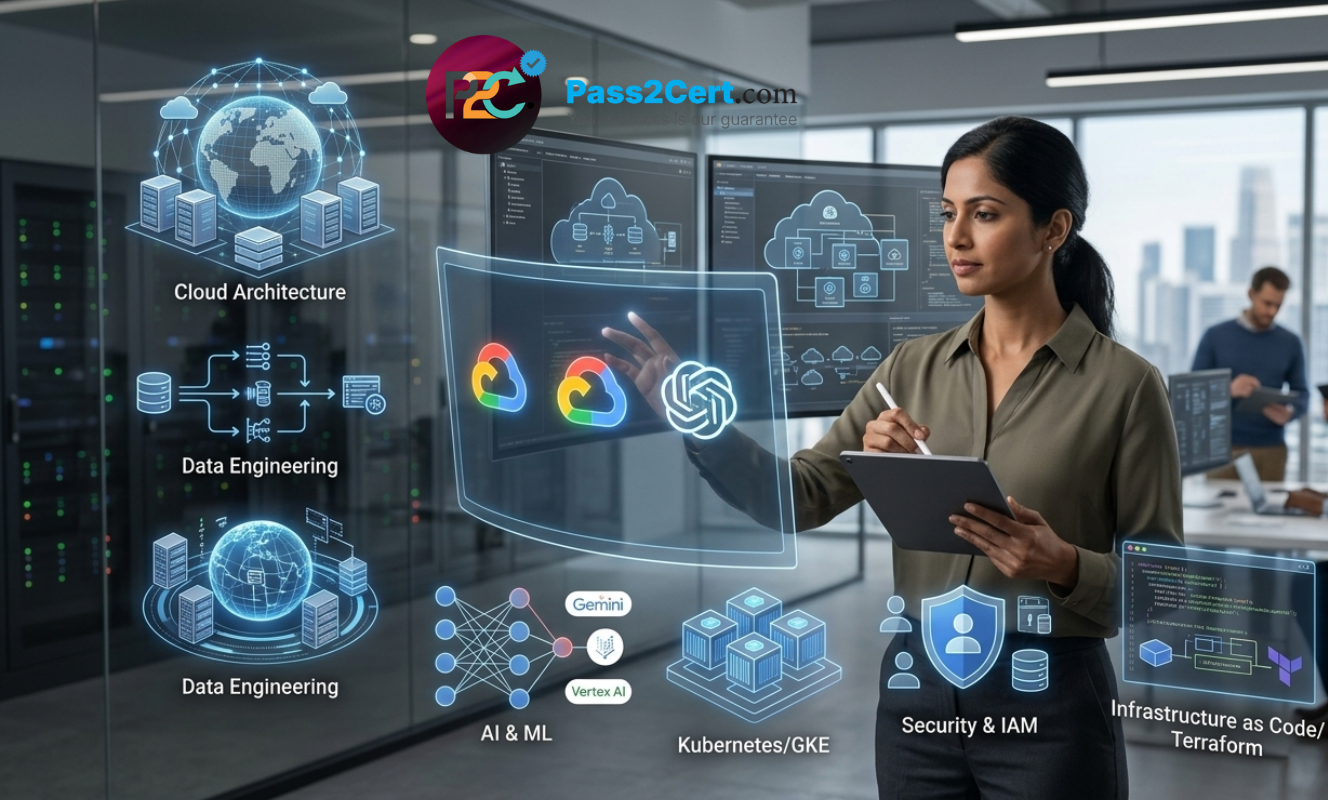
Google Cloud certifications build four categories of production-grade skills in 2026: cloud-native application development on GKE and Cloud Run, AI and ML integration through Vertex AI and Gemini APIs, data engineering at scale using BigQuery and Dataflow, and cloud security through IAM architecture, VPC Service Controls, and Zero Trust implementation. These are the skills that enterprise roles actually require, not just platform awareness.
Here is something I tell every engineer who asks me whether GCP certification is worth the study time.
The badge is almost incidental. What the preparation process builds, when approached seriously rather than as a memorization exercise, is a technical framework for thinking about distributed systems, data infrastructure, and AI integration that project-based learning rarely produces in a structured way. Engineers who work on GCP day-to-day develop deep expertise in what their specific project requires and shallow awareness of everything adjacent. Certification preparation forces systematic engagement with the entire platform surface.
Before mapping your certification strategy to specific skills, anchor it against a current guide to Google Cloud certification that reflects the 2026 exam content, because the Vertex AI and Gemini integration dimensions of the ML Engineer and Architect exams have evolved enough that older preparation materials will build skills gaps rather than close them.
Here is what GCP certification actually teaches you to do in 2026.
From Concept to Production: Cloud-Native Development on GKE and Cloud Run
What Kubernetes Mastery Actually Requires
If you are moving into a Senior DevOps role that involves GCP, the difference between knowing that Kubernetes exists and actually understanding workload management on Google Kubernetes Engine is the difference between being a deployment dependency and being the person who designs the deployment architecture.
GCP certification preparation builds GKE operational depth that goes well beyond kubectl basics. Cluster autoscaling configuration, node pool management for heterogeneous workload requirements, Workload Identity for secure pod-level GCP service access, and the network policy design that isolates workloads within a cluster are all testable content at the Professional Cloud Architect and Professional Cloud DevOps Engineer levels. These are not academic topics; they are the configurations that production GKE environments require and that engineers without certification preparation often encounter for the first time under production pressure.
Cloud Run and the Serverless Operational Model
Cloud Run mastery is a specific competency that GCP certification builds in ways that casual platform usage does not.
Understanding how Cloud Run handles concurrency, cold start behavior, and the request timeout implications for different workload types, and how to configure those parameters to balance cost against latency for specific application characteristics, requires the kind of systematic platform engagement that certification preparation forces. Engineers who develop this through study rather than trial and error in production arrive at architectural discussions with intuition that their uncertified peers have to develop the expensive way.
From Raw Data to Insight: Mastery of BigQuery and Dataflow
The FinOps Reality That BigQuery Makes Unavoidable
If you have ever dealt with a BigQuery bill that went rogue because a data analyst ran a full table scan against a petabyte-scale dataset without a partition filter, you know exactly why cost governance is a production engineering skill rather than a finance department responsibility.
Professional Data Engineer certification preparation builds BigQuery cost management instincts that are genuinely difficult to develop through project work unless you specifically work in a FinOps-focused role. Partitioning and clustering strategies that reduce query cost, slot reservation planning for predictable analytics workloads, materialized view design that amortizes expensive computation, and the query optimization techniques that reduce bytes processed, these are architectural decisions with direct cost implications that the exam tests and that production BigQuery environments require.
Dataflow and the Stream Processing Mental Model
Here is the thing about Dataflow that most engineers who have not gone through certification preparation do not fully appreciate.
Dataflow’s Apache Beam programming model requires a genuinely different mental model from batch processing architectures, understanding windowing strategies for streaming data, handling late-arriving data with appropriate triggers, and designing pipelines that maintain exactly-once processing semantics under failure conditions. The Professional Data Engineer exam builds this mental model systematically through scenario content that requires applying stream processing concepts to realistic business requirements rather than just demonstrating that you know what Dataflow does.
https://trendwavedaily.com/?p=46931&preview=true
AI and ML Orchestration: Vertex AI and Gemini Integration
What ML Orchestration Actually Means in Production
The Professional Machine Learning Engineer certification is the credential that builds the most immediately differentiated skill set in the 2026 GCP ecosystem, specifically because of how comprehensively Vertex AI has changed what production ML engineering looks like.
Vertex AI Pipelines for orchestrating multi-step ML workflows, Vertex AI Feature Store for consistent feature serving between training and inference environments, Vertex AI Model Registry for model versioning and governance, and the continuous evaluation infrastructure that monitors production models for drift, these are the production ML engineering capabilities that separate ML engineers who can train models from ML engineers who can operate them reliably at scale. The Professional ML Engineer exam tests all of these in scenario questions that assume you have actually worked with the platform.
Gemini API Integration Skills That Casual Users Never Build
But what most people miss about Gemini integration in the context of GCP certification is that the exam does not test whether you can call the Gemini API. It tests whether you can architect systems that use Gemini capabilities responsibly and cost-effectively at enterprise scale.
Understanding the cost and latency trade-offs between Gemini model variants, designing RAG architectures that use Vertex AI Search for grounding, implementing guardrails that prevent harmful outputs in production applications, and managing the token economics of high-volume Gemini API deployments are the skills that enterprise AI engineering roles require. Certification preparation builds this architectural judgment through scenario content that purely tutorial-based learning does not produce.
Identity and Security: IAM Architecture and Zero Trust Implementation
The IAM Skills That Prevent Production Security Incidents
The real value of GCP’s security content is not knowing what IAM is. It is understanding how to design IAM architectures that implement least privilege at an organizational scale without creating operational friction is what makes engineers work around the security controls.
The Professional Cloud Architect and Professional Cloud Security Engineer exams build IAM depth that includes organizational policy hierarchy design, service account management patterns that avoid credential exposure, VPC Service Controls configuration for data exfiltration prevention, and the Identity-Aware Proxy implementation that enables Zero Trust access to internal applications without VPN dependency. These are the security architecture decisions that cloud security audit findings consistently cite as deficient, and that certification preparation specifically addresses.
The Shared Responsibility Model as a Design Framework
The Shared Responsibility Model is not a compliance checkbox in GCP certification content. It is a design framework that the exam applies to specific architectural scenarios.
Understanding exactly where Google’s security responsibilities end, and yours begin, and how that boundary shifts depending on whether you are using GCE, GKE, Cloud Run, or managed services like BigQuery, changes how you architect security controls. The exam tests this applied understanding through scenarios that require identifying which security responsibilities belong to the customer in specific deployment configurations.
Infrastructure as Code: Terraform and the Operational Maturity It Requires
What IaC Proficiency Actually Produces in Production
Immediate career impact skills built through GCP certification preparation:
- Terraform module design for reusable, parameterized GCP resource configurations that teams can deploy consistently across environments
- Cloud Foundation Toolkit template usage for opinionated GCP infrastructure that embeds security best practices by default
- Infrastructure drift detection and remediation through automated state management
- CI/CD pipeline integration for infrastructure changes that applies the same testing and review standards to infrastructure code as application code
- Resource hierarchy design using organizations, folders, and projects to implement billing, access, and policy governance at scale
The Technical Growth Phases That GCP Certification Enables
The skill development trajectory for engineers who pursue GCP certification seriously:
- Foundational Phase, Associate Cloud Engineer preparation builds operational fluency across core GCP services, IAM basics, and the resource hierarchy that all advanced GCP work builds on
- Architectural Phase, Professional Cloud Architect preparation builds the design judgment to select and configure GCP services for complex business requirements with appropriate attention to cost, security, and operational complexity
- Specialization Phase, Professional Data Engineer, ML Engineer, or Security Engineer credentials build domain-specific depth in the areas where specialization produces the strongest compensation premiums
- Applied Skills Integration, Google Cloud Applied Skills credentials validate specific implementation capabilities in live environments, complementing written exam credentials with demonstrated hands-on competency
GCP certifications in 2026 build the specific skills that production cloud engineering requires,not a catalogue of service features but the architectural judgment to design systems that perform reliably, cost predictably, and maintain security under realistic operating conditions.
The engineers who extract the most career value from this certification process are the ones who treat the lab work as the core activity and the exam as the validation. Build the skills first through hands-on GCP work. Let the certification reflect what you can actually do.
That alignment between credential and capability is what produces the career outcomes that badge-collecting alone never delivers.