
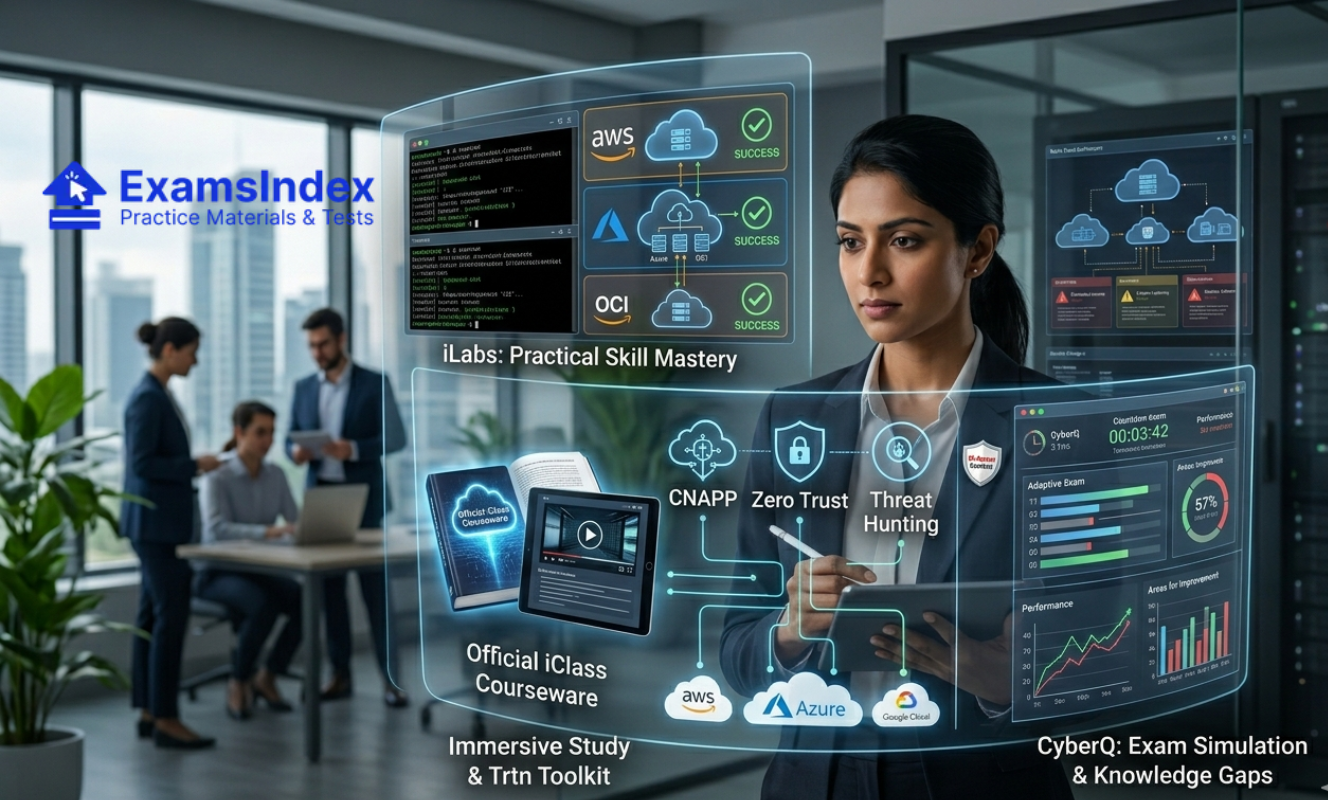
The best resources for EC-Council cloud certification in 2026 are iLabs for the hands-on terminal practice that scenario questions assume you have completed, official iClass courseware for exam-aligned theoretical foundation, including CNAPP and Zero Trust content, and CyberQ for adaptive exam simulation that identifies knowledge gaps before the actual exam exposes them. This three-resource stack produces first-attempt passes that reading-only preparation cannot match.
Let me tell you something that fifteen years of mentoring students through EC-Council’s hardest certifications has made completely clear.
If you are trying to pass the C|CSE by just reading a PDF, you have already failed. EC-Council’s cloud security examinations in 2026 are not knowledge recall tests dressed up with scenario framing. They are assessments of whether you have actually operated in cloud security environments, configured Zero Trust access policies, investigated container escape incidents, and built detection rules against real attack patterns. Candidates who have done the work pass. Candidates who have only read about it struggle in ways that additional reading cannot fix.
Before building your study plan, understand which resources for EC-Council cloud certification exams actually build the hands-on operational depth the exams test, because the resources that produce first-attempt passes in 2026 look significantly different from the PDF-and-flashcard approach that might have worked for older certification formats.
Here is the resource stack that the serious candidates use.
Terminal Time: Why iLabs Is Your Only Real Study Partner
What iLabs Actually Provides That Nothing Else Can Replicate
EC-Council’s iLabs platform provides live cloud security lab environments where you complete actual security tasks, not simulations, not click-through demonstrations, but real cloud environments where you execute attack techniques, configure defensive controls, and investigate security incidents under conditions that mirror what the exam scenarios test.
The reality is that EC-Council exams are specifically designed to test students who have not spent serious hours in the terminal. The scenario questions present realistic security situations and ask which response is correct, but the answer options are constructed to distinguish between candidates who have actually performed the described operations and candidates who understand them conceptually. That distinction only becomes apparent when you are looking at two technically plausible answers and need the operational intuition that only hands-on practice develops.
The iLabs Practice Strategy That Produces Exam Readiness
The mistake most candidates make with iLabs is completing lab exercises once, following the guided instructions, and treating them as finished.
The preparation technique that produces genuine exam readiness is completing each lab, then closing the instructions and rebuilding the scenario from memory, and then introducing a deliberate modification or misconfiguration and troubleshooting back to the correct state. That troubleshooting practice is what scenario questions actually test, and it is the specific capability that iLabs enables, and that reading-based preparation cannot develop.
The iLabs domains are most heavily weighted in the 2026 C|CSE examination content:
- Multi-cloud IAM misconfiguration identification and remediation across AWS, Azure, and GCP simultaneously
- Container security assessment, including Kubernetes RBAC misconfiguration exploitation and container escape scenario investigation
- Zero Trust architecture implementation across cloud boundaries, including Identity-Aware Proxy configuration and micro-segmentation policy design
- CSPM tool configuration for continuous cloud security posture assessment and automated remediation
- Cloud-native SIEM rule development for cross-platform threat detection and incident investigation
The Knowledge Gap Weapon: CyberQ Exam Simulation
Why Adaptive Exam Simulation Changes How You Prepare
CyberQ is EC-Council’s official exam preparation and assessment platform, and it provides a specific capability that generic practice question banks cannot offer, adaptive assessment that identifies your specific knowledge gaps rather than just presenting questions sequentially.
The adaptive assessment engine adjusts question difficulty and domain focus based on your performance patterns across sessions. Engineers who are consistently weak in cloud forensics investigation scenarios will see increased forensics question frequency until their performance in that domain reaches exam-ready levels. That targeting produces more efficient gap-closing than studying all domains equally, regardless of your actual readiness in each.
How to Use CyberQ Diagnostically Throughout Preparation
The standard candidate mistake with CyberQ, and with practice exam platforms generally, is saving it for the final week of preparation as a confidence check.
Use CyberQ from week two of preparation to establish a baseline performance profile across all exam domains. Identify the three to four domains where your accuracy is lowest. Target those domains specifically with iLabs work and iClass content review. Reassess in CyberQ two to three weeks later. That diagnostic cycle produces targeted preparation that improves your weakest areas before the exam rather than discovering them during it.
The exam simulation mode in CyberQ replicates the 2026 exam interface, question format, and time pressure conditions, including the scenario-based question style that differentiates EC-Council’s format from multiple-choice knowledge tests. Practicing under these conditions builds the time management instinct that prevents running out of time on later questions while spending too long on complex early scenarios.
Official iClass Courseware: The Theoretical Foundation You Cannot Skip
Why the 2026 Content Updates Make Official Courseware Non-Optional
EC-Council updated the official iClass courseware for C|CSE and the cloud-focused C|EH modules in 2025 and 2026 to reflect the current cloud-native security environment, specifically the CNAPP architecture content and the updated Zero Trust implementation scenarios across AWS, Azure, and GCP that now represent substantive examination domains.
Candidates using older courseware versions or third-party courses that have not been updated to reflect these changes are preparing for an exam that no longer exists in its previous form. The CNAPP content, specifically covering cloud workload protection, cloud security posture management, and cloud infrastructure entitlement management as unified security capabilities, represents a significant portion of current C|CSE examination content that pre-2025 courses do not adequately address.
How to Use iClass Content Most Effectively
The iClass courseware is most valuable when used as a conceptual framework that makes your iLabs work more meaningful, not as a standalone preparation pathway.
Read the iClass content for a domain to understand the concepts, terminology, and architectural principles. Then immediately complete the corresponding iLabs exercises to see those concepts in operational practice. Then return to iClass content to review anything the lab work revealed you did not fully understand. That cycle produces significantly deeper comprehension than either resource used independently.
The Community Edge: Where Current Exam Intelligence Lives
Why EC-Council Community Forums Are Preparation Resources
The EC-Council official community forums and specific Discord channels where active C|CSE and C|EH candidates discuss recent exam experiences provide a category of preparation intelligence that no official resource offers, current candidate feedback on which domains received unexpected weighting, which scenario types appeared more frequently than the official blueprint suggested, and which preparation approaches produced the best outcomes for recent test-takers.
Filter community discussions by recency, exam content changes frequently enough that experiences from twelve months ago may not reflect current examination content. Candidates who sat the exam within the past thirty to sixty days are describing what the current examination actually tests, which is more useful for preparation calibration than official documentation that is updated less frequently.
The Specific Community Resources Worth Engaging
The EC-Council official Discord server maintains certification-specific channels where candidates share preparation advice and recent exam feedback in real time. The r/CEH and r/cybersecurity subreddits include EC-Council certification discussion threads with genuine candidate experience reports.
When reading community exam feedback, focus specifically on reports of which domains received heavier question weighting than expected and which question types required more time than candidates anticipated. Both of these signals inform preparation prioritization in ways that studying the official blueprint alone does not provide.
The Honest Study Schedule for EC-Council Cloud Certification in 2026
The preparation timeline that produces first-attempt passes for C|CSE candidates studying alongside full-time work:
Weeks one and two: Complete iClass courseware modules for your certification track alongside initial iLabs sessions in the core security domains. Establish CyberQ baseline assessment scores across all examination domains. Weeks three through six: Targeted iLabs practice in domains where CyberQ baseline revealed the lowest performance, using the complete-rebuild-troubleshoot technique for each lab session.
Weeks seven and eight: Second CyberQ adaptive assessment cycle, iClass content review for persistently weak domains, community forum review for recent exam feedback from current candidates. Week nine: Full CyberQ exam simulation under timed conditions, gap analysis, and targeted iLabs work for any remaining weak areas. Week ten: Light review of flagged topics, exam day logistics, no new content introduction.
The bottom line is this. EC-Council cloud certification in 2026 rewards candidates who treat iLabs terminal work as the core preparation activity and courseware as the conceptual framework that makes that terminal work meaningful.
Read the concepts. Build the skills in the terminal. Let the exam reflect what you can actually do in a live cloud security environment.
That combination produces the first-attempt pass. Nothing less will reliably get you there.