
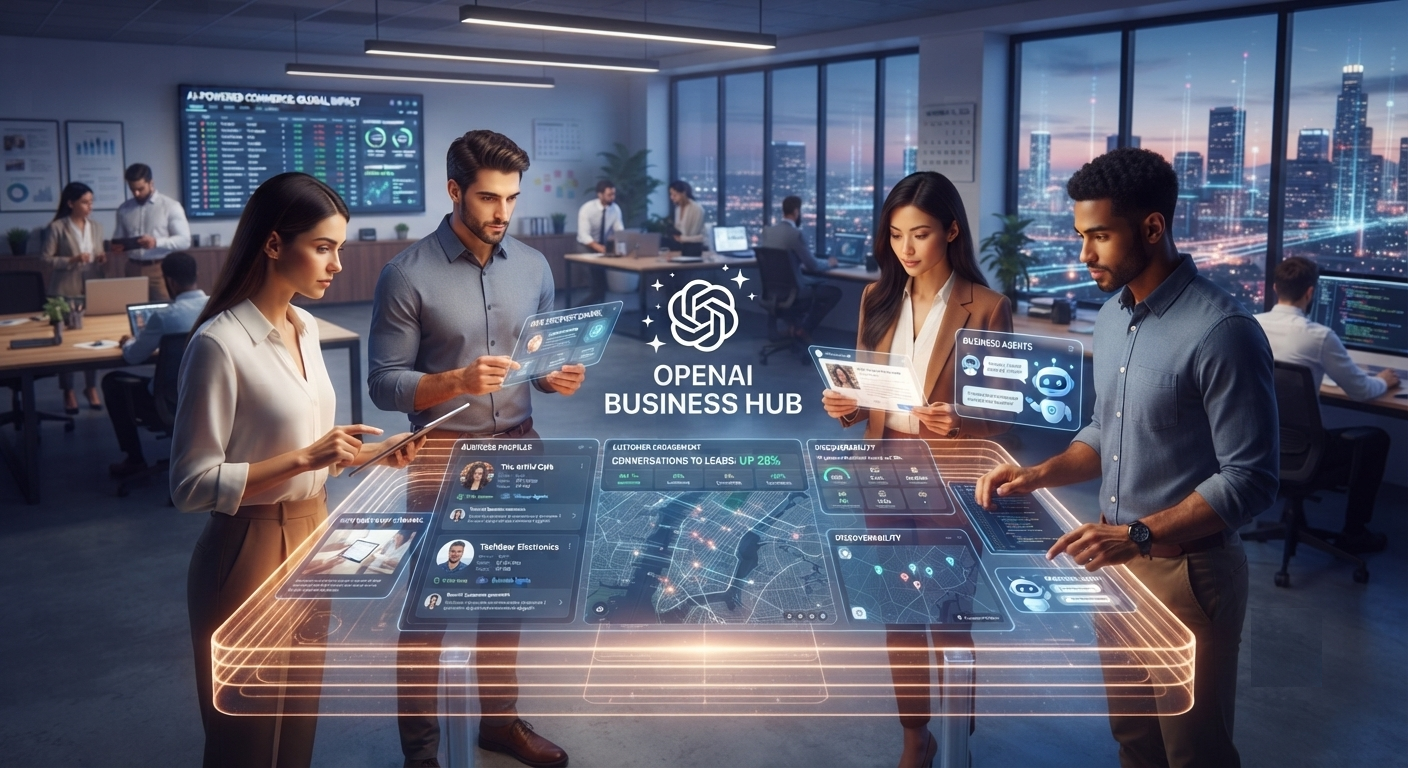
Artificial intelligence is becoming an important part of how people research products, compare services and make purchasing decisions. OpenAI is taking this development further with Businesses in ChatGPT, a new initiative that allows companies to manage their business information, understand customer engagement and create new ways to interact with potential customers directly through ChatGPT.
Announced on November 10, 2026, the initiative introduces Business Hub, business profiles and Business Agents. It allows eligible businesses to become more discoverable in AI-powered conversations while helping customers explore products and services using updated business information.
For companies, marketers and e-commerce brands, this development could create a new channel for customer discovery, although availability and features currently depend on business eligibility and location.
What Is Businesses in ChatGPT?
Businesses in ChatGPT is a beta initiative from OpenAI designed to help companies connect with people who use ChatGPT to explore products, compare options and make decisions.
Through a platform called Business Hub, eligible companies can claim their business presence, verify their information and manage important business details.
Once verified, businesses can update information and, where supported, provide product feeds containing pricing and availability.
This is important because customers increasingly use AI assistants to research questions such as:
- Which company offers the best solution for my needs?
- What are the differences between these products?
- Which service provider operates in my area?
- What features should I consider before purchasing?
By providing accurate business information, companies can help ChatGPT present more relevant details when people research products and services.
1. Businesses Can Claim Their Presence Through Business Hub
One of the main features of the announcement is the ability for eligible businesses to claim their organization through Business Hub.
After verification, companies can manage important information about their business and provide updated product details.
For e-commerce businesses, product feeds can include information such as pricing and availability. This can help customers explore offerings with more current information rather than relying only on older descriptions or incomplete product details.
OpenAI states that eligible businesses in locations where ChatGPT is available can claim their business through Business Hub. Shopify merchants can also connect their stores through Business Hub or Shopify administration to simplify verification.
This creates an additional opportunity for businesses to review how their information is represented in AI-powered discovery experiences.
2. Businesses Can Understand How People Discover Them
Another important feature is the introduction of aggregated business engagement insights.
Business Hub can provide information about:
- Business mentions in ChatGPT
- Website clicks generated through ChatGPT
- Common discovery topics where a business website is cited
These insights can help companies understand the subjects and customer questions associated with their online presence.
For example, an online clothing store might discover that customers frequently encounter its website while researching sustainable clothing, seasonal fashion or particular product categories.
A business could use these insights to identify information gaps, improve product descriptions and make its website more helpful.
OpenAI has also highlighted privacy protections. Businesses do not receive users’ private conversations or Business Agent chats. Insights are aggregated and displayed only when sufficient interaction thresholds are met.
3. Business Agents Could Change Customer Interactions
Perhaps the most interesting part of the announcement is Business Agents.
A Business Agent allows eligible organizations to create an AI-powered experience where customers can ask questions about the company’s products and services.
For example, imagine someone researching a laptop. They might want to understand the differences between two models, compare features or identify which option is suitable for their requirements.
Instead of navigating several product pages, a customer could interact with a company’s Business Agent and ask follow-up questions using the business’s information.
This creates an additional way for businesses to help interested customers understand their offerings.
However, Business Agents are not the same as ChatGPT’s independent answers. OpenAI states that these conversations are clearly labelled and remain separate from the customer’s original ChatGPT conversation.
At launch, Business Agents are available to eligible ecommerce and online service businesses in the United States. Broader availability is planned, but businesses should check OpenAI’s official eligibility requirements before assuming they can access the feature.
4. What Does This Mean for SEO and Digital Marketing?
The introduction of Businesses in ChatGPT is particularly relevant to the changing relationship between search engines, AI assistants and digital marketing.
Traditional SEO focuses on helping websites become visible in search engine results. AI-powered discovery adds another layer: businesses also need accurate, useful information that AI systems can understand and use when answering customer questions.
Companies should consider improving the following areas:
Accurate Business Information
Keep business names, addresses, contact information, services, and product details consistent across important online platforms.
Incorrect or outdated information can confuse both customers and search systems.
Helpful Product and Service Pages
Make sure key pages explain what a business offers, who its products or services are for, what sets them apart, and how customers can make informed decisions.
Avoid relying entirely on generic promotional descriptions.
Structured and Organized Website Content
Use clear headings, relevant internal links, descriptive product information, and appropriate structured data.
These improvements help organize information and make important details easier to understand.
Customer Questions and Search Intent
Identify the questions people ask before choosing a product or service.
Create useful content that addresses pricing, features, comparisons, limitations, and practical considerations. The objective should be to answer genuine customer questions rather than publish content simply to target AI-generated keywords.
Monitor AI Visibility
As AI platforms introduce more business-related features, marketers should monitor how their brands appear in AI-generated answers and which pages attract relevant website visits.
Business Hub’s aggregated insights may become another useful measurement source for eligible companies.
5. Can Businesses Advertise Through Business Agents?
OpenAI has also explained that businesses can sponsor their Business Agents and use them as destinations for ChatGPT Ads.
This creates a potential opportunity for companies to connect advertising with a more interactive customer experience.
Instead of directing every interested person to a conventional landing page, a sponsored placement can lead to a Business Agent where customers can explore an offering and ask additional questions.
Sponsored placements are clearly labelled and remain separate from ChatGPT’s independent responses.
This distinction is important because customers should be able to recognize when an interaction is sponsored rather than an independent AI recommendation.
6. Is This the Same as the ChatGPT Business Subscription?
There is an important distinction between the two terms.
Businesses in ChatGPT is the new initiative focused on business discovery, business profiles, engagement insights, and Business Agents.
ChatGPT Business, on the other hand, is a paid workspace subscription designed for organizations that want their employees to use ChatGPT in a shared business environment.
The ChatGPT Business workspace includes collaboration features, centralized billing, administrative controls and access to ChatGPT and other work tools, depending on the seat type.
These are separate offerings with different purposes. Businesses researching the new announcement should not confuse Business Hub with the ChatGPT Business subscription.
What Should Businesses Do Next?
Companies interested in AI-powered customer discovery can begin by reviewing their existing digital presence.
Here are some practical steps:
- Review the accuracy of your website’s business information, services, and product details.
- Improve important product and service pages so customers can understand your offerings quickly.
- Make pricing, availability, and relevant product information clear wherever appropriate.
- Identify the questions customers commonly ask before purchasing.
- Explore Business Hub and check whether your organization is eligible to claim its business.
- Follow official OpenAI announcements for changes in availability and new features.
Businesses should not assume that claiming a profile guarantees AI recommendations, higher rankings or increased sales. Visibility will still depend on several factors, and the new initiative is evolving.
Final Thoughts
Businesses in ChatGPT represents another step in the development of AI-powered product discovery and customer engagement.
By introducing Business Hub, aggregated engagement insights and Business Agents, OpenAI is creating new ways for companies to manage their information and interact with potential customers.
For digital marketers, SEO professionals and business owners, the announcement is worth watching. It highlights why accurate business information, useful website content, and a clear digital presence are becoming increasingly important.
AI search is not simply about getting a website mentioned in an answer. It is also about helping customers understand what a business offers and making it easier for them to take the next step.
As these features expand into more markets and business categories, companies that maintain accurate information and focus on genuine customer needs will be better prepared to adapt.