
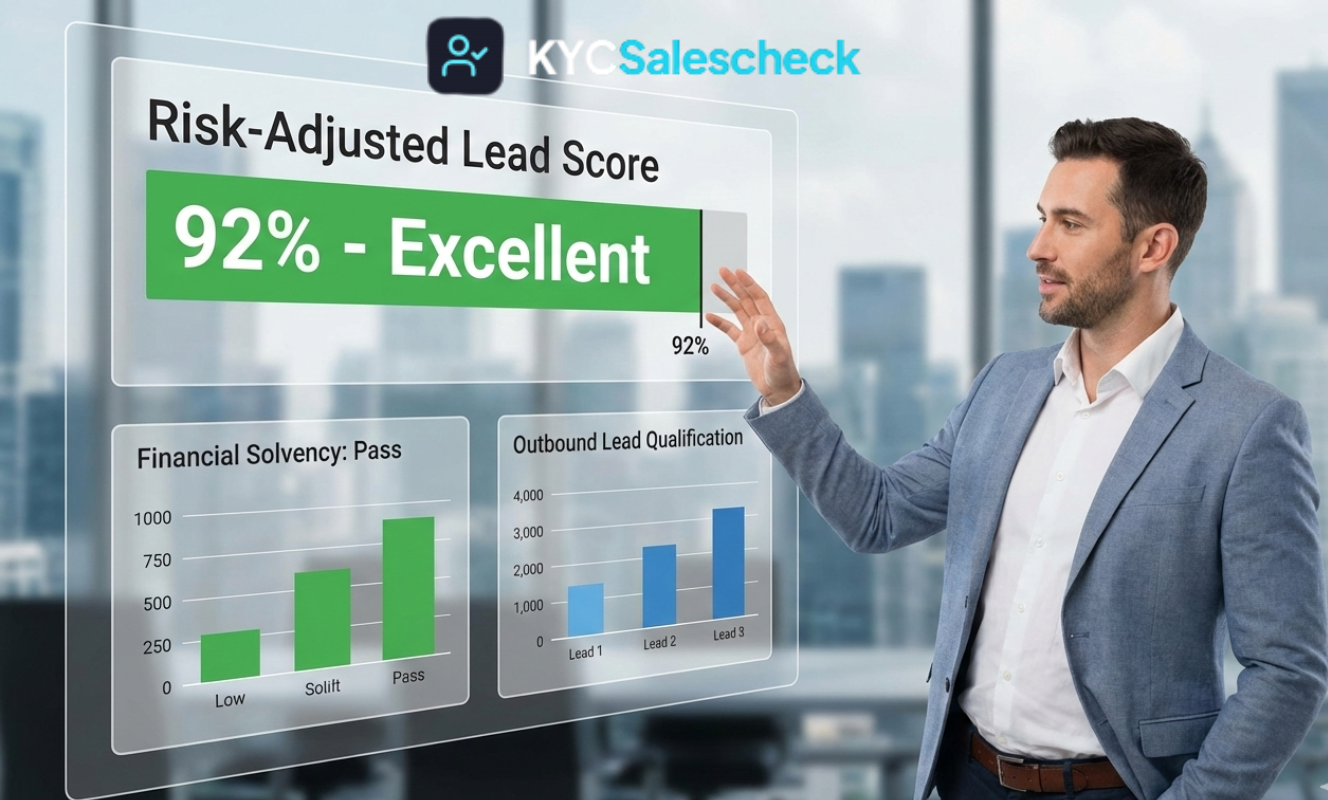
Integrating customer credit risk management into lead qualification stops sales teams from wasting time on financially unstable prospects. By checking financial health early in the funnel, you dramatically improve conversion rates, shorten sales cycles, and avoid deals that die during contract negotiations or result in payment defaults nobody saw coming.
Sales teams have gotten really good at spotting leads that look perfect. Strong engagement. Right industry. Decent company size. All the interest signals you’d want.
Then the deal dies at the contract stage because the prospect can’t pass a credit check. Or worse, closes, ships, and goes radio silent ninety days later when payment’s due.
I’ve watched this wreck sales quarters across fintech, B2B SaaS, and manufacturing. The problem isn’t lead generation quality or sales execution. It’s the massive disconnect between sales lead qualification criteria and actual customer financial risk.
Most lead scoring completely ignores the most predictive signal available, whether the prospect can actually afford to pay for what they’re buying.
Why Sales Keeps Chasing Unbuyable Leads
The ghost lead problem is baked into how things work. Sales comp rewards pipeline generation and closed deals. Risk assessment happens way downstream, handled by finance or credit teams that sales barely talks to.
Creates terrible incentives. Sales develops leads, spends weeks building relationships, customizes proposals, negotiates terms, only to find out at the finish line that the prospect’s financials make the whole thing impossible.
What Late-Stage Deal Collapse Actually Costs
When deals die after you’ve already started contract negotiations, you’ve burned serious resources. Sales rep time, obviously. But also solution engineering, executive involvement in closing calls, legal time on contracts, and finance structuring payment terms.
B2B deals dying at late stages cost 30-50% more in sunk costs compared to deals killed earlier. That’s not even counting opportunity cost, what else sales capacity could’ve closed during those weeks.
Worse is when deals close but shouldn’t have. Customer goes 60 then 90 days past due. Collections get involved. Eventually legal. Revenue gets reversed. The relationship turns hostile. And the sales rep’s commission? Often clawed back months after they’ve already spent it.
Why Regular Lead Scoring Misses This Completely
Standard lead scoring looks at engagement and company fit. Website visits. Content downloads. Email opens. Company size. Industry. Tech stack.
All useful. None of it predicts financial solvency. A struggling company shows identical engagement patterns to a healthy one when they’re researching solutions. Maybe more engagement, actually, desperate companies hunt harder for fixes to problems their stable competitors handle easily.
Outbound lead qualification has the same blind spot. SDRs build target lists based on industry, size, recent funding, job postings, and technology signals. Financial health almost never factors in.
The Sales-Risk Gap Nobody Talks About
Here’s organizational reality. Sales lives in CRM tracking engagement and deal stages. Finance lives in ERP tracking receivables and payment patterns. Credit risk happens in specialized platforms that salespeople never see.
Data doesn’t move between these systems in real time. By the time financial red flags surface, sales have already invested weeks in the relationship.
The gap kills velocity. Sales cycles get stretched by credit review processes bolted on after deals are negotiated. Deals stall while finance requests more documentation, references, and guarantees. Some prospects get annoyed by providing financial disclosures they see as invasive, after they’ve already spent time in your sales process.
What “Customer Credit Risk Management” Actually Means
Customer credit risk management is the systematic evaluation of whether a prospect can actually meet payment obligations. Traditionally handled reactively at the point of sale or credit application.
Smart organizations are pulling this way forward into lead qualification. Using financial data, credit scores, payment histories, liquidity, and debt ratios as qualifying criteria right alongside traditional engagement and company fit signals.
Not about being risk-averse. About being intelligently selective. Understanding which prospects are real revenue opportunities versus revenue risk dressed up as an opportunity.
How Modern Tools Are Closing This Gap
Lead qualification tools evolved way past engagement tracking and company filtering. Modern platforms bake financial risk data directly into scoring.
Financial Data Worth Actually Using
Business credit reports from Dun & Bradstreet, Experian Business, and Equifax Business give you credit scores, payment histories, public records, and financial stress indicators. Not perfect predictors, but way more informative than engagement metrics alone.
Payment behavior data from platforms tracking how businesses pay invoices across vendor relationships. Spot patterns of late payment, disputes, and payment plans before they bite you.
Financial statement analysis is available through public filings or supplied by prospects. Liquidity ratios, debt levels, and cash flow patterns reveal sustainability better than revenue numbers alone.
Bankruptcy and legal records surface early warnings before situations blow up. Liens, judgments, and ongoing litigation all signal elevated risk worth knowing about.
Scoring That Actually Predicts What Closes
Effective lead scoring in 2026 weighs financial health heavily. Not exclusively, strong engagement from financially challenged prospects might signal urgency worth exploring with proper risk mitigation. But financial risk becomes an explicit variable instead of an ignored elephant in the room.
Weighting that’s worked across B2B contexts:
- Engagement and intent signals: 30-40%
- Company fit: 20-30%
- Financial health: 30-40%
- Existing payment behavior for expansions: 10-20%
The exact mix depends on your industry, deal size, and payment terms. The point is that financial health carries similar weight to traditional sales criteria.
Making Outbound Actually Work Through Financial Intelligence
Outbound lead qualification improves massively when financial health becomes a targeting criterion from the start.
Building Lists That Actually Convert
Instead of targeting every company matching industry and size, filter for financial health appropriate to your deal size and payment terms.
Selling $50K annual contracts with net-30? Target companies with business credit scores above your minimum threshold for reliable payment. Exclude companies with recent delinquencies, judgments, and financial distress signals.
Doesn’t eliminate your addressable market. Focuses effort on the chunk actually capable of becoming paying customers. A smaller qualified market beats a larger unqualified market every single time.
Sales Development That Respects Reality
Train SDRs to spot and note financial warning signs during prospecting calls. Companies mentioning cash flow issues, payment flexibility needs, or weirdly aggressive negotiation on terms before even seeing pricing are worth noting.
Not automatically disqualifying. But flagging for additional financial diligence before heavy sales investment. Maybe these prospects need different deal structures, shorter terms, guarantees, or routing to specialized teams handling higher-risk deals.
What Actually Improves: Velocity, Conversion, Profitability
When financial risk moves from end-of-deal gatekeeping to early qualification, multiple things get better simultaneously.
Sales Cycles Get Shorter
Deals don’t stall waiting for credit approval because credit was addressed during qualification. Sales invests time in prospects already vetted for financial fit. Fewer surprises. Faster movement from proposal to signature.
Organizations doing this report 20-30% cuts in average sales cycle length consistently. Not from rushing, but from eliminating time spent on deals that were never closable.
Conversion Rates Actually Go Up
Conversion from qualified lead to closed deal improves when “qualified” includes financial viability. Fewer leads might qualify under stricter criteria, but way higher percentage actually close.
Better to qualify 100 leads and close 40 than qualify 200 and close 50. Same revenue. Half the wasted effort. Double the efficiency.
Customer Lifetime Value Gets Protected
Customers acquired through financially aware qualification deliver better lifetime value. They pay on time. They’re stable enough for multi-year relationships. Less likely to churn from business failure.
Bad customers cost more than lost revenue. They eat support resources. Create operational chaos. Kill team morale. Tie up collections and legal. Sometimes damage the brand through public disputes.
Filtering for financial health at qualification prevents these situations instead of managing them after they explode.
Making This Operational: What Changes
Weaving customer credit risk management into sales ops isn’t just plugging in technology. It’s a process change and cultural shift.
Data Integration Stuff
CRM needs connections to business credit sources. Either native integrations, middleware, or APIs. Financial risk scores need to be surfaced directly in CRM, where sales live, not buried in separate systems requiring manual lookup.
Scoring Gets Rebuilt
Lead scoring algorithms need reworking to incorporate financial variables. Requires collaboration between sales ops, revenue ops, and finance. Defining thresholds, weights, and refresh cadences for financial data.
Sales Training and Enablement
Sales needs help understanding what financial indicators mean and how to discuss them professionally. “Your credit score doesn’t meet our threshold” needs way more nuanced communication than “You don’t fit our ICP.”
Training should cover spotting financial red flags, asking appropriate questions about stability, and positioning financial qualification as a mutual interest in a successful partnership rather than gatekeeping.
Getting Sales and Finance Aligned
Only works if sales and finance operate as partners instead of adversaries. Finance needs to understand sales pipeline pressure and revenue targets. Sales need to understand risk management and what payment defaults actually cost.
Regular joint pipeline reviews where both engagement metrics and financial risk are discussed create shared accountability for revenue quality, not just revenue quantity.
The Advantage of Getting This Right
Organizations ahead on this are winning deals that competitors chase unsuccessfully. Building healthier customer bases with better payment behavior. Converting pipeline to revenue faster with fewer resources.
More importantly, they’re treating sales lead qualification as a strategic capability instead of an admin function. Understanding that qualification accuracy determines everything downstream, including sales efficiency, revenue quality, customer satisfaction, and profitability.
Financial risk shouldn’t surprise you at the contract stage. It’s information that should inform every stage from initial targeting through ongoing account management.
Companies figuring this out in 2026 aren’t just improving lead qualification accuracy. They’re fundamentally rethinking how sales velocity and enterprise risk management actually work together.
Because revenue you never collect isn’t revenue. It’s just expensive storytelling that blows up your quarter three months later.
And nobody has time for that anymore.