
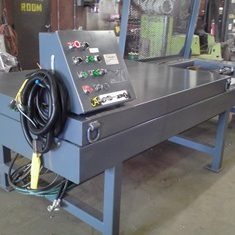
In industries where safety, durability, and performance are non-negotiable, accurate mechanical testing is essential. From rigging equipment and wire rope assemblies to chains, shackles, and synthetic slings, every load-bearing component must meet strict standards before entering service. This is where a Pull Testing Machine becomes a critical tool, helping manufacturers, inspectors, and engineers verify product integrity through precise proof loading and break testing.
As a trusted U.S. manufacturer, ProofCert designs and builds advanced mechanical testing machines that support accurate certification and compliance across demanding industries. Understanding how pull testing machines work and why they matter can help organizations improve safety, reliability, and operational confidence.
What Is a Pull Testing Machine?
A pull testing machine is a mechanical testing system designed to apply controlled tensile force to a material or product until it reaches a specified proof load or fails. The machine measures force, elongation, and deformation, providing critical data about the strength and performance of the tested item.
Pull testing is commonly used for:
-
Wire rope and cable assemblies
-
Chains and shackles
-
Synthetic slings and roundslings
-
Rigging hardware
-
Fasteners, fittings, and mechanical components
By simulating real-world loads in a controlled environment, pull testing machines ensure that products can safely perform under operational stress.
Why Pull Testing Matters in Industrial Applications
In sectors such as construction, manufacturing, marine operations, oil and gas, and material handling, failure of a single component can lead to costly downtime or worse, serious injury. Pull testing plays a vital role in preventing such risks.
1. Safety Assurance
Testing verifies that products meet or exceed their rated load capacities. Proof loading ensures that equipment can handle expected forces without permanent deformation, while break testing confirms ultimate tensile strength.
2. Regulatory Compliance
Many industries must comply with national and international standards. Pull testing provides documented evidence that components meet required specifications, supporting audits and certifications.
3. Quality Control
Manufacturers rely on pull testing machines to validate production consistency. Routine testing helps identify defects, material inconsistencies, or design weaknesses before products reach customers.
4. Product Development
Engineers use test data to improve designs, select appropriate materials, and optimize manufacturing processes, leading to safer and more durable products.
Key Components of a Pull Testing Machine
Modern pull testing machines are engineered for precision, repeatability, and durability. While designs vary depending on capacity and application, most systems include:
-
Load Frame: A robust structural frame designed to withstand high tensile forces
-
Hydraulic or Mechanical Actuation: Applies controlled pulling force to the test specimen
-
Load Cells: High-accuracy sensors that measure applied force
-
Grips and Fixtures: Securely hold different types of samples without slippage
-
Control System: Allows operators to set test parameters and monitor performance
-
Data Acquisition Software: Records force, displacement, and test results for reporting
Advanced systems, such as those developed by ProofCert, integrate user-friendly controls with industrial-grade durability for long-term reliability.
Proof Loading vs. Break Testing
Pull testing machines are used for two primary testing methods, each serving a distinct purpose.
Proof Loading
Proof loading involves applying a specified load usually a percentage of the product’s rated capacity without causing permanent deformation. The goal is to verify structural integrity while keeping the component serviceable.
This method is commonly used for:
-
Rigging gear certification
-
Periodic inspection programs
-
Compliance with safety standards
Break Testing
Break testing applies increasing force until the product fails. This destructive test determines the ultimate strength and failure characteristics of a component.
Break testing is essential for:
-
Design validation
-
Failure analysis
-
Research and development
Both methods are critical, and a versatile pull testing machine should support each with accuracy and repeatability.
Applications Across Industries
The versatility of a pull testing machine makes it valuable across multiple sectors.
Rigging and Lifting Equipment
Wire ropes, chains, shackles, and slings must withstand extreme loads. Pull testing verifies load ratings and ensures equipment is safe for lifting operations.
Manufacturing and Fabrication
Manufacturers use pull testing to validate welds, fasteners, and assemblies, ensuring consistent quality across production batches.
Marine and Offshore Operations
Saltwater environments and heavy loads demand robust components. Pull testing confirms that marine hardware meets safety requirements before deployment.
Construction and Infrastructure
Structural components and lifting gear used on construction sites are tested to prevent failures that could compromise worker safety.
Custom vs. Standard Pull Testing Machines
Not all testing needs are the same. Some organizations benefit from standard testing systems, while others require custom solutions.
Standard Machines
Ideal for common testing applications, standard pull testing machines offer predefined capacities and configurations suitable for many industries.
Custom Machines
For specialized products, oversized components, or unique testing requirements, custom-engineered machines provide tailored solutions. ProofCert specializes in designing custom mechanical testing systems that match exact client specifications, ensuring accurate and efficient testing.
Benefits of Choosing a High-Quality Pull Testing Machine
Investing in a reliable pull testing machine delivers long-term value beyond basic compliance.
-
Improved Workplace Safety
-
Reduced Equipment Failures
-
Accurate and Repeatable Results
-
Compliance with Industry Standards
-
Enhanced Customer Confidence
High-quality machines also reduce maintenance downtime and improve overall testing efficiency.
The ProofCert Advantage
ProofCert is recognized for manufacturing some of the most advanced mechanical testing machines in the industry. Their systems are designed to certify products through proof loading and break testing with precision and durability.
Key strengths include:
-
U.S.-based manufacturing
-
Expertise in rigging and load testing applications
-
Custom and standard machine solutions
-
Advanced control and data systems
-
Commitment to accuracy, safety, and reliability
By focusing on real-world testing challenges, ProofCert delivers equipment that supports both compliance and operational excellence.
Best Practices for Pull Testing
To maximize the effectiveness of a pull testing machine, organizations should follow best practices:
-
Calibrate Regularly: Ensure load cells and sensors maintain accuracy
-
Use Proper Fixtures: Secure samples correctly to prevent slippage or uneven loading
-
Train Operators: Skilled operation reduces errors and improves safety
-
Document Results: Maintain detailed records for audits and quality control
-
Inspect Equipment: Routine maintenance extends machine life and reliability
These practices help ensure consistent, trustworthy test outcomes.
Conclusion
A Pull Testing Machine is more than just a piece of equipment it is a cornerstone of safety, quality, and compliance in modern industry. From certifying rigging gear to validating product designs, pull testing provides the data and confidence needed to operate safely in high-load environments.
With its focus on advanced engineering, customization, and reliability, ProofCert continues to support industries that demand precision and trust in mechanical testing. Investing in the right pull testing solution not only protects products and people but also strengthens long-term operational success.